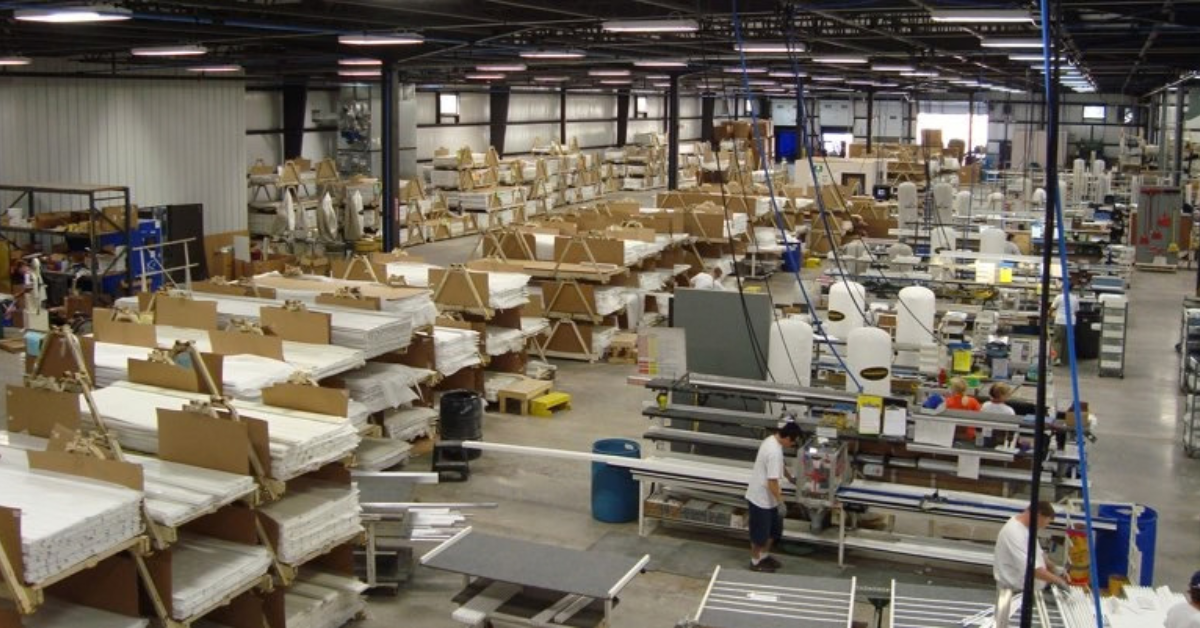





When most people think about companies embracing American manufacturing, challenges like tariffs, shipping delays and global instability come to mind as reasons why.
But for Polywood, it’s a different story. Brady Miller, Polywood’s CEO, tells Casual News Now that inventory management is one of the most important pillars of Polywood’s business.
“A long time ago, we did some investigative trips overseas and decided that the best path for us was domestic production,” Miller said. “We wanted to build a low-to-no-inventory customized furniture business that could deliver in real time and in a seasonal industry. And I think one of the big paradigms in our industry is that it is seasonal. Most people believe the only way to deal with the seasonal industry is to stabilize the workforce year-round, build up inventory and hope you built up the right inventory.”

Polywood decided that inventory limited its retailers’ growth and has been dedicated to its mission of providing quality custom furniture quickly.
“The big pattern in our industry is too much inventory,” he said. “Everybody is addicted to inventory, and they don’t know how to achieve a highly seasonal business without building a lot of inventory. There’s a lot of risk there. And what do you do to mitigate risk? Inventory is all about risk mitigation, which is contrary to aggressive sales.”
All of Polywood’s 50,000 options can be built and shipped on a short timeline — anywhere from a few days to seven to 10 days for more complex products. For most, he said, the process takes 12 to 14 weeks.
In addition to the company’s no-inventory strategy, they also have a zero-waste approach that has grown stronger over the years.
Polywood processes over 100 million pounds of resin, and none of it ends up in a landfill. Miller said this is one of the things he’s most proud of about the company.
“There are several factors that go into it,” he said. “One is that the materials we use have to be recyclable. That’s a big deal. Then for our process of manufacturing, any scrap that’s made in the process is able to be recycled. We can grind it up and turn it into something brand-new again. Taking it one step further, even things that end up on the floor, like shavings, can be collected and used for something new.
Miller said it’s fun to find ways to make things without creating waste and that it’s taken a lot of coordinated teamwork and commitment to get the company to where it is today.
And while Polywood has heavily incorporated automation into its processes, Miller said it will never undervalue the people behind the machines. He believes the interesting thing about the evolution of automation is that while some people think machines will eliminate jobs, he thinks it creates them.

“We have 2,000 positions at Polywood now, and we’re still growing,” he said. “We added automation and engineering, and we were able to add operators to run them. It’s been extraordinary to see that happen, and to see the wage growth we’ve been able to achieve by using different tools.”
Looking forward, Miller said Polywood will be focusing on artificial intelligence. Ben Spiegel recently joined the company as chief digital officer, and Miller said he has a “great vision on integrating AI into the business.”
“Over the last year, we have grown leaps and bounds as an organization regarding how we’re utilizing technologies and large language models. And we’re just getting started,” he said. “Everybody’s using AI already, so the real question is, can we harness that energy and align and facilitate it? We’ve been empowering AI versus trying to control it.”
He compares the rise of AI to the rise of the internet back in the early 2000s — often termed the Wild West days of the internet. Except this time, it’s moving much faster. An example of how Polywood uses AI is how it engages with its data. All of the data is centralized, and they can access data and analytics in real time through AI.
“Then you extend that capability to the organization, and now your people on the shop floor are using an LLM model to access the data to make decisions in real time. Once you get your data centralized, you can query the data. The tools are there to empower the organization in a way that wasn’t there even two to three years ago.”