



Few will argue that 2025 was a challenging year for the casual furnishings industry. From tariffs to unfavorable spring weather conditions across wide swaths of the United States, both retailers and manufacturers felt the negative impacts of challenges that mostly remained out of their control.
As we embark on 2026, we asked a variety of industry leaders where they think the outdoor business stands now, what challenges and opportunities will arise during the months to come and what they think this new year holds for our category.
The three-part State of the Casual Industry report will examine those questions and more. Want to weigh in? Reach out to me at jennifer@homenewsnow.com to share your insights and opinions. And in the meantime, here is Part I of our report.
Where does the casual industry stand today?
Most in the outdoor category said they don’t feel overly positive about where the industry stands now or what the year ahead holds.

“I think we’re slightly better off than the indoor furniture business, but it’s pretty tough,” said Tom Murray, CEO, NorthCape. “I think the feeling going into 2026 is that there’s still a lot of caution and hesitation. Demand is cool, to say the least. I don’t think anybody’s running around happy.”
Though the calendar flipped to a new year, many of the same issues that plagued 2025 — namely tariffs, inflation and an overall slow economy — will continue to impact both retailers and manufacturers as we move into 2026.
“I don’t want to say it’s another year of doom and gloom, but I think the economy’s still an issue,” said Brad Schweig, vice president of operations, Sunnyland Outdoor Living. “I think people are still overextended. I feel it personally in my own pocketbook — we are not doing any significant discretionary spending.”

Many retailers had a tough 2025, with economic challenges and less-than-optimal weather patterns keeping consumers out of stores. And in some cases, that contributed to closures, such as that of Yard Art in Texas, as well as bankruptcy filings for larger merchants such as At Home.
“After several years of soft demand of either flat or down years, I think several of the dealers are having difficulties paying their bills,” said Bew White, executive chairman, Gabriella White/Summer Classics. “That said, there are a lot of people getting into the business, and I think they’re having some success.”
Outside domestic manufacturers — many of whom saw a bump in business last year because of tariffs on imports — those finding success have been willing to push the envelope, bringing innovative designs to market.
“The industry is moving slower than we’d like,” said Todd Wingrove, vice president of sales, Agio. “Consumers are still adjusting to higher prices from tariffs, and the housing market hasn’t helped. Still, there’s steady interest in well-designed, differentiated products.”
Fresh design isn’t the only ingredient for success. Offering a range of product that can’t be easily found elsewhere, along with the option to customize, has been a winning strategy for many in the industry.

“Most of whom I’ve spoken to are optimistic about 2026 and are anticipating the return of ‘some regularity’ to the industry (although many admit it’s probably going to be a ‘new kind’ of regular),” said Mike Fredrichsen, vice president of sales, Pasticallo. “Several have commented that they’re stepping into 2026 cautiously with more variety, less stock and a focus on uniqueness, flexibility, special orders and a memorable buying experience.”
And with many consumers tightening the belt this year, the demand for furnishings that will last — both from a material and style standpoint — has grown. Casual manufacturers and retailers must offer customers furniture that will stand up to the rigors of exterior use and constantly changing trends.
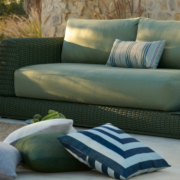

“The casual industry is entering 2026 with a more informed and intentional consumer base. Now more than ever, customers are comparing materials when weighing prices and are looking for long-term value,” said Telly Varga, marketing director, Three Birds Casual. “There is a growing interest in longevity, maintenance (or lack thereof) and true performance in harsh conditions. We’ve seen a growing consumer base who is searching for trend-proof solutions that will outlive the current trend cycle. This leads us to believe that people are thinking longer term about their patio space.”
Many in the industry think 2026 will be less chaotic in regard to tariffs, which could give consumer confidence a much-needed boost. And according to Castelle President Rory Rehmert, those in the upper-mid to high-end will benefit from that shift in sentiment.

“I think that we are coming off of a year where consumers may have delayed their purchases due to all of the back and forth on tariffs. Now that the dust has settled somewhat, consumers will be back and more likely to buy,” he said. “Interest rates have fallen slightly, and this will help drive home sales and home update projects. I do think the season will be trying for retailers that are focused on mid- to low-end product.”
Ultimately, most in the industry agree that this year will remain tricky to navigate, but those who have a solid grasp on their brand identity and their customers’ needs will be most likely to come out on top in the end.

“I think there is a lot of uncertainty out there,” said Leisa McCollister, vice president of marketing, OW Lee. “I see the retailers who are driving forward and have a clear vision of who they are doing really well right now. I don’t think it is a time to be timid in the market.”
Next week: We’ll look at some of the challenges and opportunities facing the casual industry in 2026.