



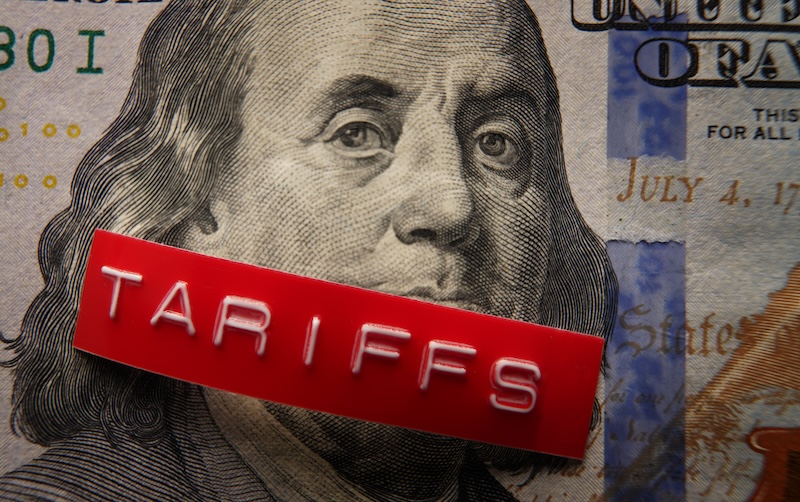

With the Supreme Court expected to rule on the Trump Administration’s tariffs possibly as soon as Friday, the furniture industry anxiously awaits clarity on what the duties will be going forward for imports. At last week’s International Casual Furnishings Association’s Elevate Conference, Chris Andresen, senior vice president at lobbying firm Dutko Government Relations, said the court may not bring the resolution many are hoping to receive.
“Arguments have been heard, and there are a lot of bets on what’s going to happen,” he said. “But I think that unfortunately may throw some additional uncertainty into the issue.”
At the heart of the issue is the president’s invocation of the International Economic Emergency Powers Act to impose significant tariffs on goods from nearly all of the nation’s trade partners. The IEEPA was enacted in 1977 and gives the president authority to regulate international commerce after declaring a national emergency or extraordinary threat to the nation. Trump leveraged the IEEPA on the basis of controlling the flow of illegal drugs into the U.S. and remedying trade deficits. But this usage isn’t what was intended by the act.
“The argument is that the IEEPA was not meant to be this broad,” Andresen said. “It wasn’t meant to impose tariffs on the entire world.”
Andresen said that there are at least five justices — both Democrats and Republicans — who have expressed skepticism over that authority. But since this is an unprecedented situation, he said the court has taken their time to consider the next move.
“This is the first time it has been done, but ultimately, it’s the Supreme Court’s decision,” he said. “And this is part of the wildcard, because once that happens, that’s one of the first dominoes. Then we have to hold on to see what the next dominoes are for this situation.”
Trump also established product-specific tariffs on everything from steel and aluminum to upholstered furniture under Section 232 of the Trade Expansion Act of 1962, which allows the president to impose tariffs on imports deemed a threat to national security based on Department of Commerce investigations. The steel and aluminum duties, which are set at 50%, have been particularly troublesome for the casual furnishings industry.
The Section 232 tariffs also were challenged in the courts, but the case was thrown out. Andresen said that while some of the investigations for those tariffs have been settled by the Department of Commerce, several are still in progress, and these duties may be more long-term than their IEEPA-based counterparts. Same with Section 301 tariffs, which account for most of the duties on Chinese imports.
“An investigation takes around nine months, and the president didn’t want to wait that long, so that’s why this route wasn’t chosen initially,” Andresen said. “The administration is setting the stage for more solid legal ground since many of these investigations have already been settled.”
Andresen said that even if the Supreme Court ultimately rules that the IEEPA-based duties are un-Constitutional, we’re not out of the weeds yet when it comes to tariffs.
“You could potentially see a reduction, but then you still have to navigate the 232 and 301 tariffs and what those rates look like,” he said.
Another factor that could impact how the tariff situation plays out is this year’s midterm elections. Less than 24 hours after Andresen’s session at the ICFA conference, six Republican lawmakers joined Democrats in the United States House of Representatives in a 219 to 211 vote to rescind President Donald Trump’s tariffs on Canadian goods.

Though the vote is largely symbolic, as it still needs approval in the Senate and sign-off from Trump, it points to the role of tariffs in the upcoming election cycle. Dutko said some more vulnerable Republicans may continue to side with Democrats on tariffs, which have proven to be unpopular — a recent Pew Research Center poll found that 60% of Americans disapprove of Trump’s tariffs, and 39% of those strongly disapprove.
“There have already been tariff disapproval votes in the Senate where Republicans joined Democrats to push back,” he said. “Obviously the administration is trying to make sure those votes don’t happen, but in an election year, it makes for an interesting problem for some.”
While the Trump Administration has touted the amount of revenue it has made from tariffs — $264.05 billion in 2025, according to the U.S. Treasury Department — many have questioned how those funds are being used.
“Even when you’re making $90 billion, you’re still running huge deficits in the federal government,” Andresen said. “How does that get reinvested?”
The Supreme Court’s ruling may be a hit on Trump’s tariffs, but Andresen said it will not solve the problem or make these duties go away anytime soon.
“Tariffs aren’t going away,” he said. “They’re ready for those next dominoes to fall. There’s a reason the president chose this method to impose these fares because it was immediate, it was broad and it helped him accomplish his goal right away, which we know is what he likes.”